[Service Design]
W+ Fitness Service
Designing a beginner-friendly fitness learning journey

By integrating a mobile app, coaching support, and beginner-friendly gym environments, the service explores how digital and physical experiences can work together to reduce barriers for first-time gym users.
[Context]
This project was developed in 2018–2019, before the rapid growth of AI-driven personalization and integrated fitness ecosystems.
At the time, most fitness solutions focused on content delivery or activity tracking, with limited support for beginner learning journeys.
Looking back, this project can be seen as an early exploration of how structured guidance, spatial design, and digital tools could work together—an approach that aligns with many emerging fitness experiences today.
[Role]
Service design research
UX/UI Design
Spatial concept design
Concept video production
[Team]
2 Designers
[Timeline]
Sep 2018 – Apr 2019 (8 months)
[Tools]
Sketch
Adobe Illustrator
After Effects
[Why This Project]
At the time, I was also a beginner interested in strength training, and personally experienced the uncertainty and intimidation many women face when entering gym environments.
This project began from a simple question:
"How might we create a fitness experience where beginner women feel safe, supported, and confident enough to start strength training?"
Through interviews, gym observations, and personal experience, the project explored how digital guidance and physical environments could better support beginners entering fitness spaces.
[Process]

[02] Define
💡
Synthesized key beginner pain points
🎯
Defined target users and design opportunities
📝
Framed the core service challenge
[03] Develop
📱
Designed integrated app + gym experiences
🏫
Explored onboarding and spatial guidance concepts
👀
Created service flows and prototypes
[04] Deliver
🎛️
Produced app prototypes and concept video
📍
Visualized key touchpoints and interactions
📨
Gathered exploratory user feedback
1.1 Industry Research
Research period: 2018
1. Increasing use of mobile booking
As smartphones became more widely adopted, users increasingly booked fitness classes through mobile devices. According to data from the fitness reservation platform 17Fit, the percentage of bookings made through mobile devices increased from 65% to 75% between early 2017 and early 2018.
2. The rise of smart and unmanned gyms
Fitness services began integrating apps, wearable devices, and automated systems to improve user experience and operational efficiency. Emerging smart gyms explored replacing parts of traditional coaching with data-driven recommendations and real-time workout tracking.
3. Growth potential in women’s fitness services
According to the 2018 Survey on Sports Consumption Expenditure in Taiwan, women consistently showed a higher willingness than men to spend on fitness courses and coaching services. The report suggested that fitness providers should better understand women’s exercise preferences and reduce barriers that may prevent participation.

1.2 Competitive Analysis
To better understand the existing fitness ecosystem in 2018, we analyzed several types of fitness services, including workout apps, coaching services, gym ecosystems, and workout-tracking tools.
The analysis focused on how these services supported beginners throughout their fitness journey — especially in terms of onboarding, guidance, motivation, and confidence-building.

[Key Findings]
Existing fitness apps focused heavily on content and tracking
Apps such as Nike Training Club and Keep provided workout videos, structured programs, and fitness tracking tools. However, most experiences still relied on users being self-motivated and confident enough to navigate fitness independently.
Coaching services provided guidance, but introduced psychological and financial barriers
Personal coaching offered the strongest learning support and real-time feedback, but beginners often felt uncertain about pricing, coaching quality, and whether the experience would match their expectations.
Gym ecosystems prioritized operations over onboarding
Gym apps mainly focused on reservations, memberships, and operational convenience. Less attention was placed on helping beginners feel comfortable entering gym environments for the first time.
[Design Opportunity]
Most existing services focused on either workout content, coaching, tracking, or gym operations. Few services addressed the emotional barriers beginners face when transitioning from "I want to start exercising" to "I feel confident entering a gym." This became the foundation for W+.
1.3 User Interview
How do people transition from complete beginners to building sustainable fitness habits?
We interviewed 10 amateur fitness participants aged 20–30, including:
The goal was to understand how people gradually build long-term exercise habits.
[1.3.1 Persona Matrix]
Based on interview findings, we mapped fitness users across two dimensions: level of self-motivation and clarity of fitness goals.
We focused on beginner users interested in weight training for general health and body maintenance, but who needed external support to get started.
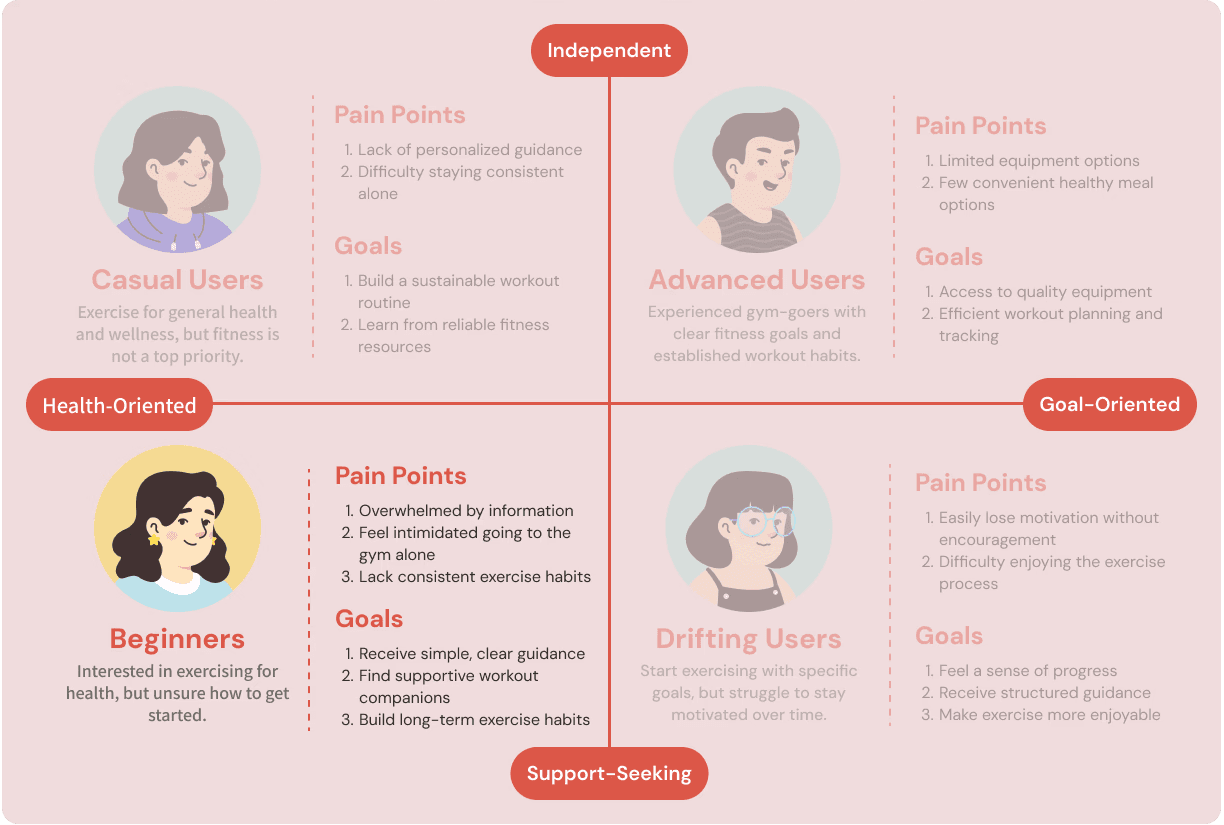
A common characteristic among these users was the desire to build healthier habits through weight training, while lacking confidence, knowledge, or clear direction in the early stages.
We further divided beginner users into two groups:
Users with some budget who are willing to seek professional coaching directly
Users who prefer to explore the gym independently before committing financially

[1.3.2 Interview Insight]

Affinity Diagram of the Interview
By comparing the learning journeys of beginners and experienced users, we identified the key differences that help beginners take the first step and build a sustainable fitness habit.
[A. Pain points in the beginner learning journey]
01 The foundational knowledge required to get started feels overwhelming:
Beginners often don't know where to begin — and without prior context, an abundance of options makes the problem worse rather than better.

02 Most beginners feel unfamiliar with gym equipment and fear getting injured through incorrect use:
Most beginners feel intimidated by gym equipment, and that fear of doing something wrong keeps them from engaging with it at all.

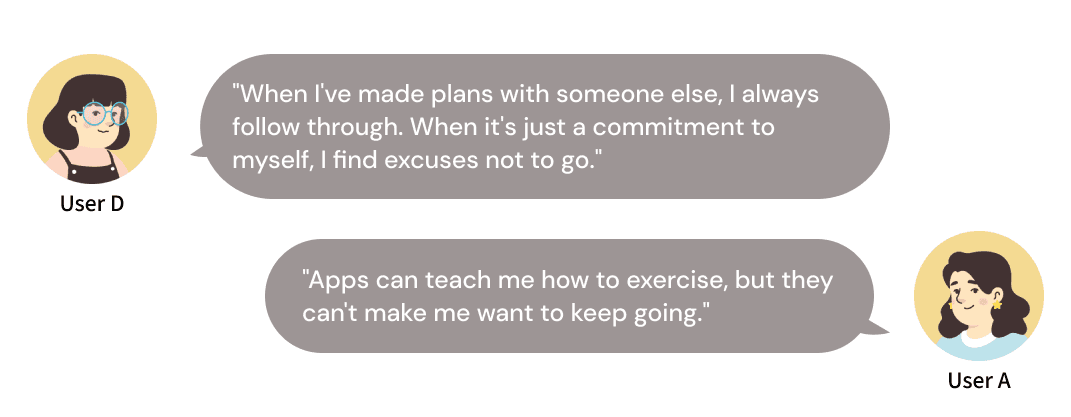
03 Real companions are more motivating than apps alone:
When it comes to showing up, accountability to another person consistently outweighs self-motivation — something apps have yet to replicate.
[B. How experienced users learned]
Among the users we interviewed, those who had maintained a fitness habit for 2–3 years shared two common traits:
1. Clear goals
They pursued specific objectives such as improving their physique or athletic performance, and built structured training plans around these goals.
Guided learning
Male participants more often learned independently through online resources, while female participants typically entered the gym through someone with experience. Across both groups, coaches or experienced individuals played an important role in sustaining long-term progress.
[1.3.3 Journey Mapping]

Through journey mapping and gym observations, we identified three major service gaps:
Intimidating Gym Environments
Unfamiliar equipment and experienced users created psychological pressure.
Difficulty Maintaining Motivation
Many users struggled to sustain exercise habits after their initial attempts.
[Key Insight]
Comparing beginner and experienced users revealed a critical gap:

The core challenge is not access to information, but the absence of a guided learning experience.
2.1 User Pain Point Analysis
Through conversations with experienced exercisers and fitness coaches, we learned that weight training is a sport that requires customized, systematic learning. Learning from fragmented sources alone risks poor results and potential injury. This makes the role of a guide especially critical in a beginner's learning journey.
However, when we explored why most users are reluctant to seek guidance, we found that the issue lies not in the absence of coaching services, but in how those services are perceived. High costs — combined with uncertainty about what the service actually provides — reduce beginners' willingness to commit.
2.2 Design Goal
"How might we, through the integration of digital tools and physical environments, remove the barriers that prevent beginner women from starting their fitness journey?"
We aimed to use digital onboarding and data analysis alongside in-person staff and thoughtful spatial planning to create a supportive community that helps users feel at ease and stay motivated to exercise consistently.
2.3 Our Hypotheses
Provide an introductory quiz, guided onboarding, and foundational knowledge at the start of the service experience.
Improve wayfinding and signage in the gym; provide detailed movement instructions for each piece of equipment.
Allow users to explore the gym independently first, then use data analysis to recommend coaching sessions when progress plateaus.
Help users clarify their goals and experience small, concrete signs of progress to sustain motivation.
Build meaningful and trustworthy social connections to increase long-term engagement.
2.4 Challenges and Constraints
01. Limited resources and team size With only two designers, we focused on defining the core service concept and maximizing the impact of each deliverable.
02. Gym spatial planning varies by venue The physical environment could only be presented as a concept. Real-world testing and iteration were not feasible within the project timeline.
03. Social and community features were deprioritized Hypothesis 05 — building meaningful social connections — was identified as a valuable direction, but was not developed into a concrete design solution due to resource constraints. If revisiting this project, community-driven onboarding would be a key area to explore further.
Based on the hypotheses defined in the previous phase, we explored how digital and physical touchpoints could work together to support both user types — ultimately converging on an integrated service model where the app, the gym environment, and coaching support reinforce each other rather than operating in isolation.
4.1 Service Channels
W+ integrates three interconnected channels: the mobile app, the gym environment, and coaching support. These channels work together to create a seamless learning experience — the app guides users before and after visits, the space supports independent exploration, and coaches provide structured progression when users are ready.

4.2 Service Proposal
We proposed W+, an integrated fitness experience designed specifically for beginner women.
The concept combines:
digital guidance (app)
spatial design (gym environment)
human support (coaching)
to create a structured and supportive learning journey. The goal is to help users transition from hesitant beginners to confident gym users.
[Concept Video]

To address the trust barrier identified among Type 1 users, the service concept introduced several touchpoints designed to make the coaching experience more predictable and transparent.
Pre-class preview
Before a session begins, users receive an outline of what the upcoming coaching session will cover, allowing them to set realistic expectations and arrive with a clearer sense of what they will learn.
In-session sync & Post-session Q&A
During the session, coaches record the user's movements and performance directly within the app, which is immediately synced to the user's personal account.
After the session, users can continue asking questions through the app's built-in Q&A feature, maintaining an ongoing learning dialogue with their coach beyond the gym.
Training collection
Exercises covered in coaching sessions are saved to a personal reference library that users can revisit during independent training.
Together, these touchpoints shift the coaching experience from an opaque, one-time transaction toward a more continuous and legible learning relationship — reducing the uncertainty that often prevents beginners from committing to professional coaching.
To reduce anxiety for users who prefer to explore on their own, the service introduced several spatial and digital design solutions:
Exploring Map
A step-by-step onboarding flow helps users understand basic training concepts, identify personal goals, and receive a personalized beginner workout plan.
Color-coded gym zones
Equipment areas are categorized by floor color, helping users quickly locate relevant machines without needing prior knowledge.
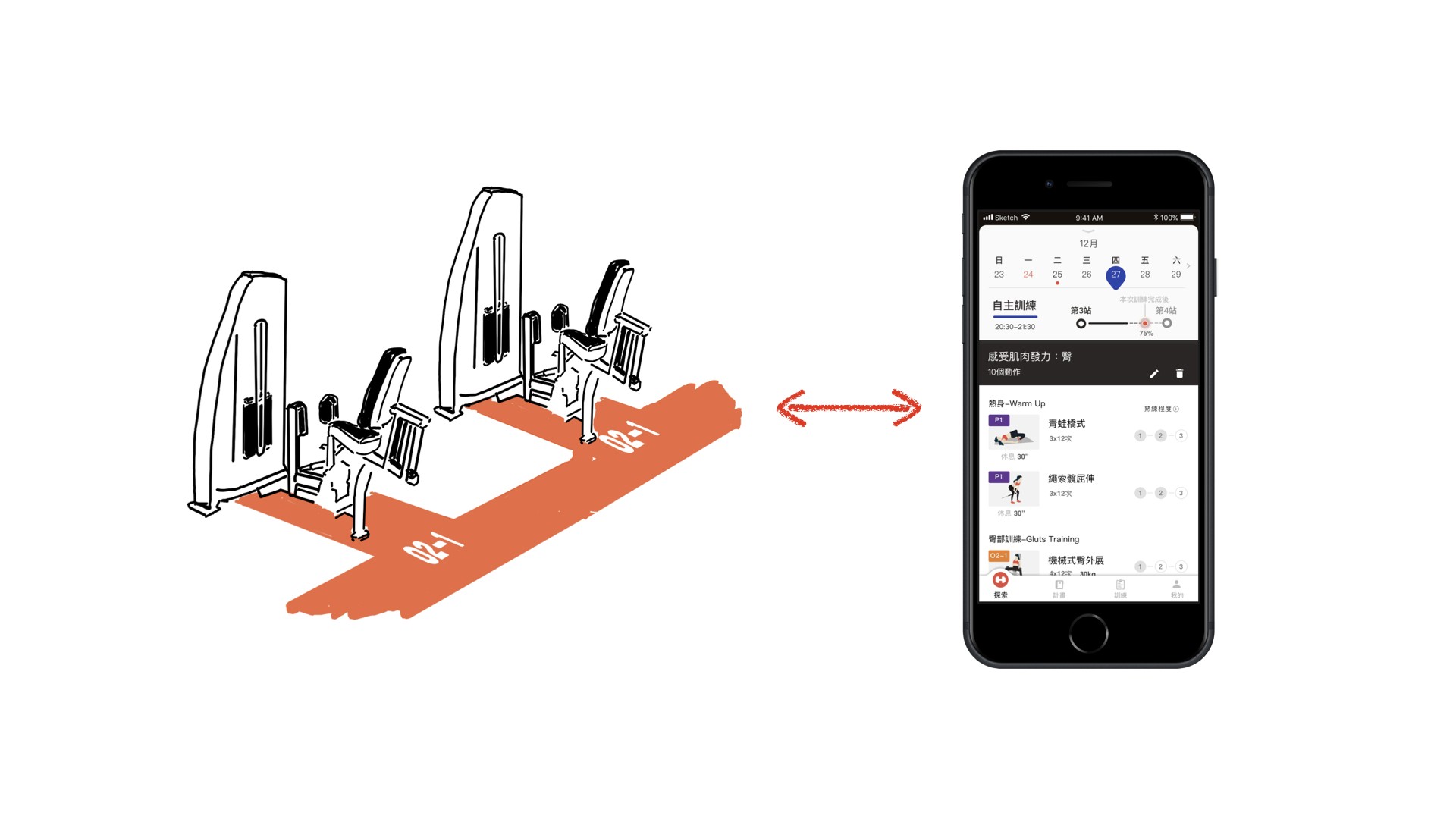
Equipment tutorials
QR codes or sensors connected to the app allow users to access instructions and movement demonstrations on-site.
Data-driven coaching recommendations
As users train independently, the app tracks progress over time. When performance plateaus, the system suggests transitioning to coaching sessions — creating a gradual, low-pressure path from self-guided to professionally guided training.
[Reinforcing progress and motivation]
Long-term motivation is closely tied to visible improvement. The service supports this through:
Progress tracking — A dedicated area within the gym (designed with the privacy of a changing room, with marked reference positions for consistent photo angles) allows users to document physical changes over time.
Achievement rewards — Users earn points upon completing workout goals, which can be exchanged for rewards through an in-gym redemption system.
Simplified data visualization — The app presents only the most relevant personal metrics for beginners, such as individual equipment weight progression, in a format that is easy to understand at a glance.
[Full Prototype]
The following prototype screens were developed to validate the service concept and key user flows. Visual design reflects the standards of 2018–2019.
Given the timeline constraints of this project, formal usability testing was not conducted. In retrospect, a more rigorous validation approach would involve two phases.
The first phase would focus on understanding the participant's context — their current fitness habits, how they learned to exercise, what pain points they encountered, and which apps or services they currently used. This would ensure that feedback in the second phase was grounded in real experience rather than abstract reaction.
The second phase would involve a guided walkthrough of the concept video, pausing at key moments to capture first impressions and responses. Core questions would include:
What feelings or impressions does this design give you?
How does this feel different from services you currently use?
Are there any features or design decisions that feel unclear?
Recruiting from the original target group — beginner women with limited gym experience — would be essential to ensure the feedback reflected the actual design intent rather than the perspective of already-confident gym users.
01. Making the most of limited resources
Working in a two-person team on a complex service design project required clear communication, careful prioritization, and constant adjustment. This experience taught me how to plan within constraints while still delivering a coherent, meaningful proposal.
02. Translating research into design decisions
Fitness is a relatively mature domain. Throughout the project, we continuously questioned whether our design directions were grounded in actual user needs — and iterated accordingly. The challenge was not finding insights, but making sure the solutions genuinely addressed them.
03. Revisiting W+ from a 2026 perspective 👀
Returning to this project in 2026, some of what W+ tried to solve through design has since been addressed by technology — automatic workout detection, personalized recommendations, and simplified logging are now baseline capabilities. In that sense, parts of the solution feel less differentiated today.
What remains resilient is the core problem: AI has not meaningfully lowered the emotional threshold of walking into a gym for the first time. The spatial design concepts — creating an environment that signals "this is for you" — stay relevant precisely because they address something algorithms cannot fix.
There are also areas where AI would strengthen the original concept. Coach matching is now a tractable problem, and real-time movement feedback through computer vision could begin to answer the question beginners most want answered — "am I doing this correctly?" — without a coach being physically present.
The design opportunity has shifted: not "how do we provide better information," but "how do we use better tools to free up human attention for the moments that actually require it.".
04. Future opportunities
Community-driven onboarding that recreates the "guided by someone you trust" dynamic identified in the research
AI-assisted coach matching to reduce the reliance on chance in finding a compatible coach
Movement feedback through computer vision to address beginners' fear of incorrect form
Real-world pilot testing in gym environments to validate spatial concepts and measure behavior change